
Finding The 100 MPG Carburetor Or What is 100% MPG?
New England Primer "/ePRESS/" Home Page.
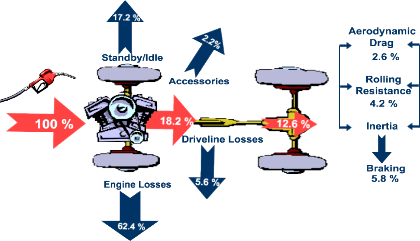
The graphic below is courtesy of [https://www.fueleconomy.gov/feg/atv.shtml]. Go to that page for detailed information on all of the losses.
This calculation is only a "What if"
because the graphic only shows the "losses". If it
showed the "TOTAL Work Output" at the
wheels it could used for a graphic of the Conservation of
Energy.
Assuming the "TOTAL
Work Output" = 5.8 % , then let's assume that that equals 20 MPG
and that 1 gallon of gas costs $3/Gal. and where
the Higher Heating Value [HHV] of 1 US gallon of
gasoline = 125,000 Btu/gallon.
[ 20 MPG out/
5.8 % out = 3.448 mpg for each 1.0% point of Total
Work Output. And that 1.0% of $3 = $0.03
. In other words: 1.0% of the Totals = 3.448 mpg
and = $0.03]
Then filling in the blue table from left
to right:
 |
||||||||||||||||||||||||||||||||||||||||||||||||||||||||||||||||||||||||
If "TOTAL Work Output" = 5.8% = 20 MPG , the cost of the fuel converted to Output is: $ .174 |
Again, this says that a gallon of gas in a "20 mpg" car typically expends 94.2% which is equivalent to: 324.8 mpg and $2.82 of $3.00/gal. to "losses". This doesn't sound very good but consider that:
- This also says that regenerative attachments are barely going to compensate for their complexity and added maintenance.
- This also says that hybrid attachments are barely going to compensate for their complexity and added maintenance.
- This also says that electric vehicles would only shift the chemical fuel energy transition losses to the power company and add electrical power transmission losses to the total. The car above uses raw chemical fuel energy and transforms it into mechanical motion. The power company would take raw chemical fuel energy transform it into mechanical motion (with losses) to generate electricity, distribute it over power lines (with losses) to charge & store in a car's batteries (with losses) and the electric car would change the stored electricity (with losses) into mechanical motion.
- The most economical use of raw fuel energy resources with the least amount of wasted losses is to change it once from chemical fuel energy to mechanical motion. Ref.: 3rd party calculations for electric cars: Battery-Powered or Hybrid Cars and Hydrogen-Powered Vehicles . Large selection of resources at the botttom of this page.
- The most economical use of the raw fuel energy resources due to Engine LOSSES (i.e. 78,000 BTU) is to capture it and convert it into mechanical motion. See next table.
|
If the 1000°
F exhaust gases were used for auxiliary steam engine
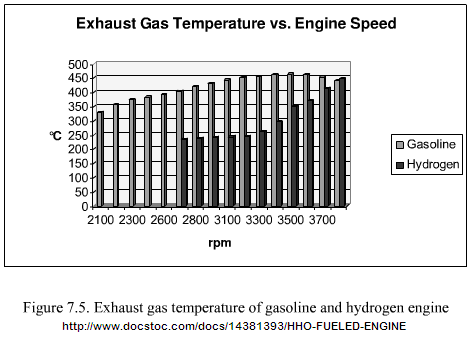
propulsion with the same losses, what would be the resulting MPG? Before you think you are going to get something for nothing, you should consider the process of "Diminishing Returns". In this example this says that if you get auxiliary steam power out, it will reduce the fuel required to power the car from point A to B; therefore, the hot exhaust gasses will be less and the auxiliary steam power available will be less. Here's a patented example of current steam power: https://en.wikipedia.org/wiki/Crower_six_stroke ; or search. But simpler methods might be available now. Figure to the right shows at 2100 rpm (about 42 mph) the temp = 325º C = 617 º F |
 |
CH4 + 2 O2 ? 2 H2O + CO2 Water is a waste product."
"Spontaneous chemical processes do not create energy, they release it by converting unstable bonds into more stable bonds and/or by increasing entropy. Water is such an abundant chemical compound in part because it has very stable bonds that resist most reactions. In order for water to participate in a reaction that produces energy, high energy compounds must be added to carry the current and make H2O bonds easier to break. For example, it is possible to generate the combustible fuel hydrogen by adding sodium bicarbonate [NaHCO3.] to water. See [3.] above.
[7.]
"As already noted, water, particularly when ions
are added (salt water or acidic water) can be electrolyzed
(subject to electrolysis). When driven by an external source of
voltage, H+ ions flow to the cathode to combine with electrons to
produce hydrogen gas in a reduction reaction. Likewise, OH- ions flow
to the anode to release electrons and an H+ ion to produce oxygen gas
in an oxidation reaction.
In molten sodium
chloride, when a current is passed through the salt the anode oxidizes
chlorine ions (Cl-), which release electrons to the anode. Likewise the
cathode reduces sodium metal (Na+), which accept electrons from the
cathode and deposits on the cathode as sodium metal. valence shell.
Table Salt as the catalyst. ...
NaCl dissolved in water can also be
electrolyzed. The anode oxidixes chlorine ions (Cl-), and Cl2
gas is still produced. However, instead of sodium metal, aqueous sodium
hydroxide (NaOH) is produced, which stays dissolved in the water. Some
of the water will also be electrolyzed, producing H2
gas. The oxygen is found in the hydroxide ion which
combines with the sodium ions to make the sodium hydroxide.
The
net equation is: 2 H2O (l) + 2 NaCl (aq)
--> Cl2(g/aq) + 2 NaOH (aq) + H2
(g)" [https://en.wikipedia.org/wiki/Electrolytic_cell
]
(l) = liquid ;
(aq) = aquious ? ; (g/aq) = gas/aq? ; (g) = gas
| Hydrogen Technology Applications, Inc. (HTA) has recently completed an initial round of testing with a Ford F250 (diesel) and on-board system producing Aquygen gas. HTA was able to show about a 21% increase in fuel economy for these initial tests. Results from this testing can be seen at this [BUSTED link.] | Stanley
Meyer YouTube videos "LA to NY would use 22 gal. of water" (...about 126 miles per gallon of water. On this reasoning one of those 1 qt. mason jars should last 30 miles if it provided 100% of the fuel of the vehicle. Since they only supply about 20-25% "boost" the 1 qt. jar should last about 150 miles. You would expect to fill up the jar about twice per tank of gasoline. ) |
 |
|
 |
<<
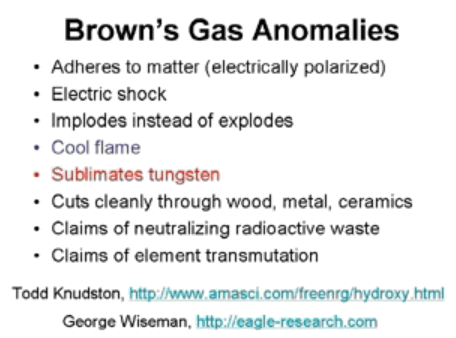
Todd
Knudtson: HYDROXY [
http://amasci.com/freenrg/hydroxy.html ]
Quotes Eric Kreig's "Brown's Gas" skeptical discussion (Long
critical rant trying to get his mind around these unique
properties of water.) << George Wiseman, http://eagle-research.com (Website is typical of book sellers - teases and gives conflicting messages.) John Kanzius' Water Fuel Cell - Video - Online |
Finding The 100 MPG Carburetor Or What is
100% MPG? The answer is dependent upon
the "gallon" you are referring to.
~
Designed - © 12/22/07 ; 28 Kb .
.
| Italic magenta edits by ed. PAGE PATH: |
Dear C.You told me that before you got your Cadillac, you did some research on maintenance records and durability of cars. What did you come up with. I think it was a Honda that gave you the best results. Or was it a Nissan? Or something else? I am thinking about getting a car for S. to go to school with, as I may have a part-time job starting in the fall. Or I may let her have the 2002 Pontiac Gran Prix, and I'll get something used.C.